Rocket Lab: The Space Platform
As the space economy shifts from government to commercial players, Rocket Lab USA Inc. rises as a challenger to SpaceX's dominance.

The space industry is growing at a fast pace, along with new use cases that need specialized companies to offer them. This context is promoting the emergence of companies dedicated to various space services, including satellites, launches, space infrastructure, defense and security.
The global space economy is expected to grow to $1.8 trillion by 2035, as highlighted in this McKinsey article: Space: The $1.8 trillion opportunity for global economic growth. Below, you can see a graph showing the expected CAGR from 2023 to 2035, in both reach (space technology helping companies across industries) and backbone (satellites, launchers, and services like broadcast television or GPS).
The leading company in the sector, as you may know, is SpaceX. Valued at approximately $350 billion, it has developed high-capacity rockets such as the Falcon 9 and operates a satellite constellation called Starlink. The Falcon 9 has a payload capacity of 23 tons, making it specialized in delivering large payloads.
On the other hand, Rocket Lab (RKLB from now on) is a public space company dedicated to providing end-to-end space services and is specialized on small satellite launch services. Next, we will discuss the qualitative characteristics on which I have built my investment thesis and that, in my opinion, give the company a strong moat.
Leadership
One of the biggest assets of RKLB is its founder, president, and CEO, Sr. Peter Beck (SPB). Born in New Zealand, he founded RKLB in June 2006 and owns the 10% of the company nowadays. After listening to several interviews, you can easily decipher he is a sharp-minded individual with big aspirations, great engineering skills and an overwhelming personality. Truly one of a kind.
“The space business is going to start to look a little blurry about what is a space business and what is a services business” - SPB
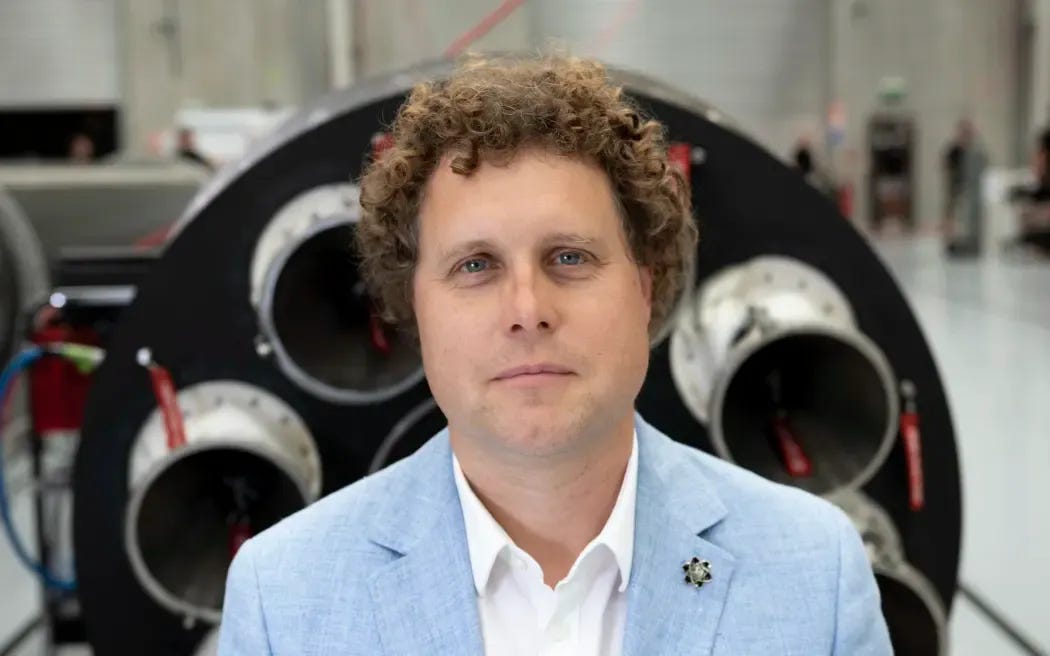
I would love to share with my readers one of the best interviews he’s had: ‘Is Neutron almost ready? Peter Beck interview’ by Markets with Madison. It’s a great summary of the current situation of the company and what he expects to happen next.
Business model
The fanciest part of the business is rockets. The company has focused on providing access to space for small satellites using the Electron rocket, which has been launched 58 times as of the time of writing. It is a two-stage rocket made of carbon composite and uses LOX and Kerosene as propellants. The rocket is specialized in delivering satellites to precise and unique orbits. Its first stage is reusable, enabling more frequent launches without increasing production costs and helping to reduce overall launch expenses.
It is important to highlight the world’s largest 3D printer, which is used to print carbon composite components. This enables Rocket Lab to manufacture its own components without relying on third parties, reducing costs and avoiding issues that could cause delays in space programs.
“We’re combining our proprietary flight-proven carbon composite technology, additive manufacturing, and autonomous robotics to design and build large-scale aerospace components at a pace that will support not only Neutron’s launch cadence, but support Electron and carbon composites structures for our spacecraft customers too.” - SPB

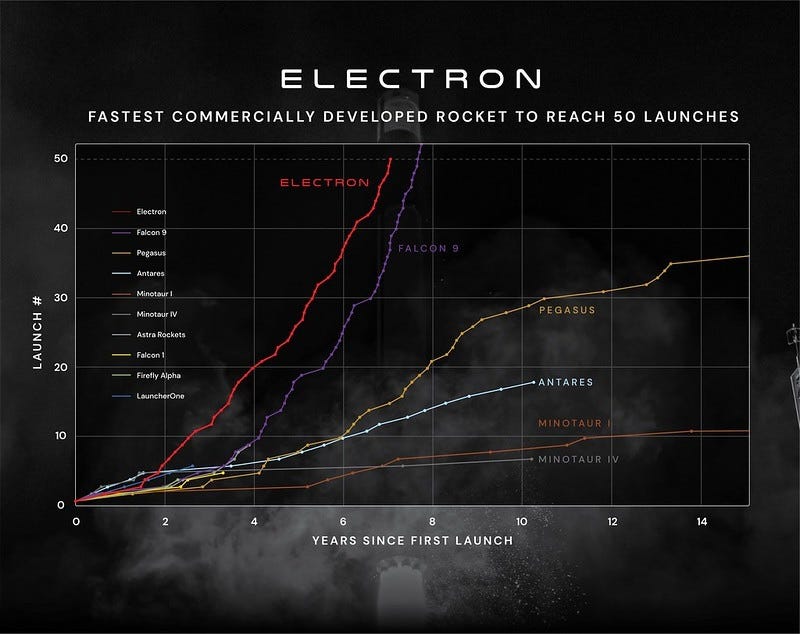
In the picture below, you can see that ELECTRON is, indeed, the fastest commercially developed rocket to reach 50 launches, surpassing Falcon 9. This achievement is yet another example of the company’s exceptional execution excellence.
The company offers other launching services, such as HASTE (Hypersonic Accelerator Suborbital Test Electron) which provides reliable, high-cadence flight test opportunities needed to advance hypersonic and suborbital system technology development. This enables RKLB to provide services to military and defense customers.

The company has three launch pads. The first two are at Mahia (New Zealand) and the other is at Wallops Island (Virginia, US). This means the company can launch from both hemispheres, providing greater flexibility to choose the best window for a launch.
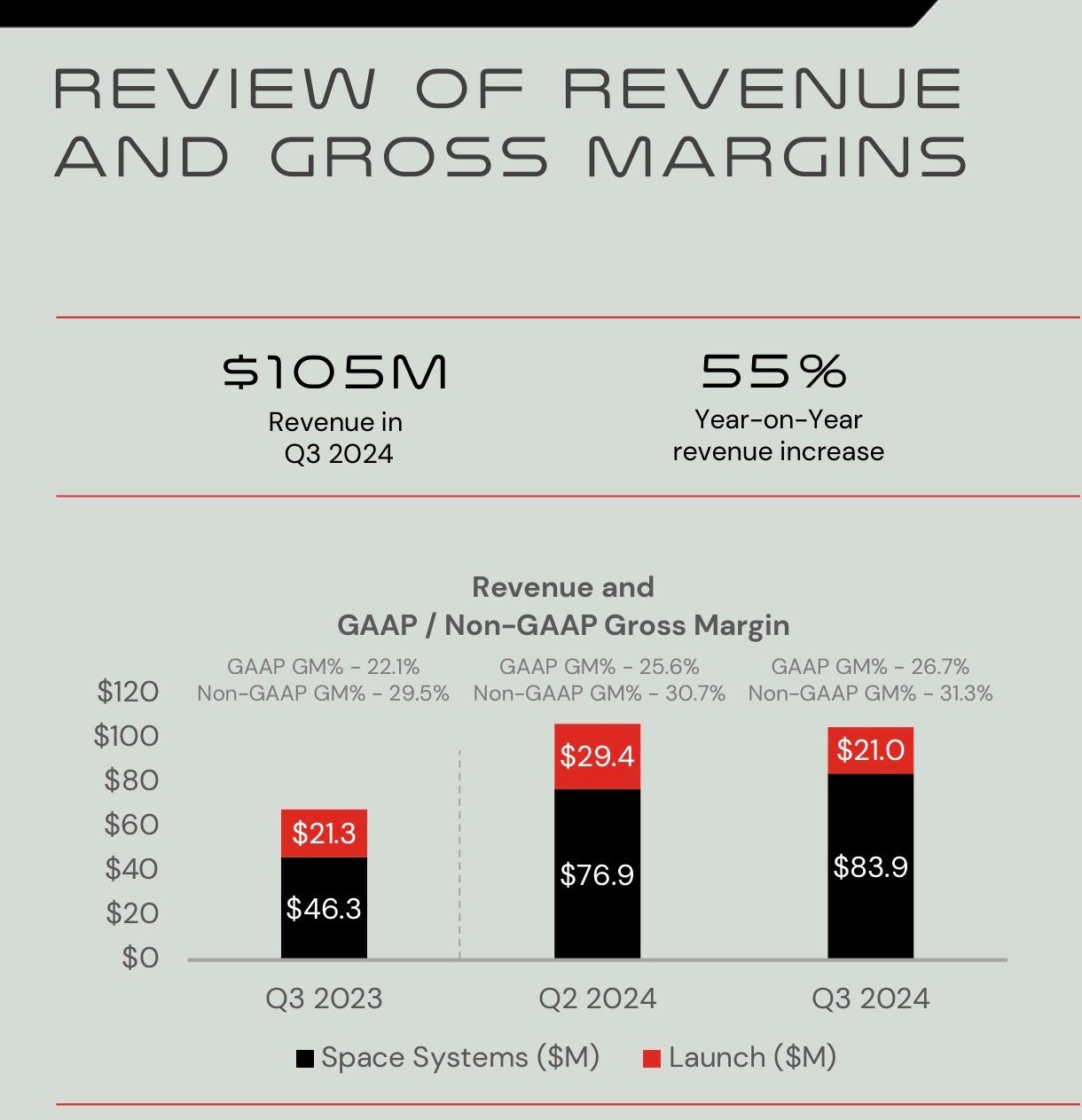
However, rocket services are not the company’s biggest revenue stream. As you can see in the graph below, space systems accounted for almost the 80% of the revenue in Q3 2024. I attribute this success to the SPB’s vision on the profitability of the company and all its acquisitions.
Here’s the list of acquisitions:
Sinclair Interplanetary (April 2020): Satellite hardware.
Advanced Solutions Inc. (October 2021): Space software and mission simulation capabilities.
Planetary Systems Corporation (December 2021): Designs and manufactures satellite separation systems.
SolAero Holdings, Inc. (January 2022): Solar power solutions for spacecraft.
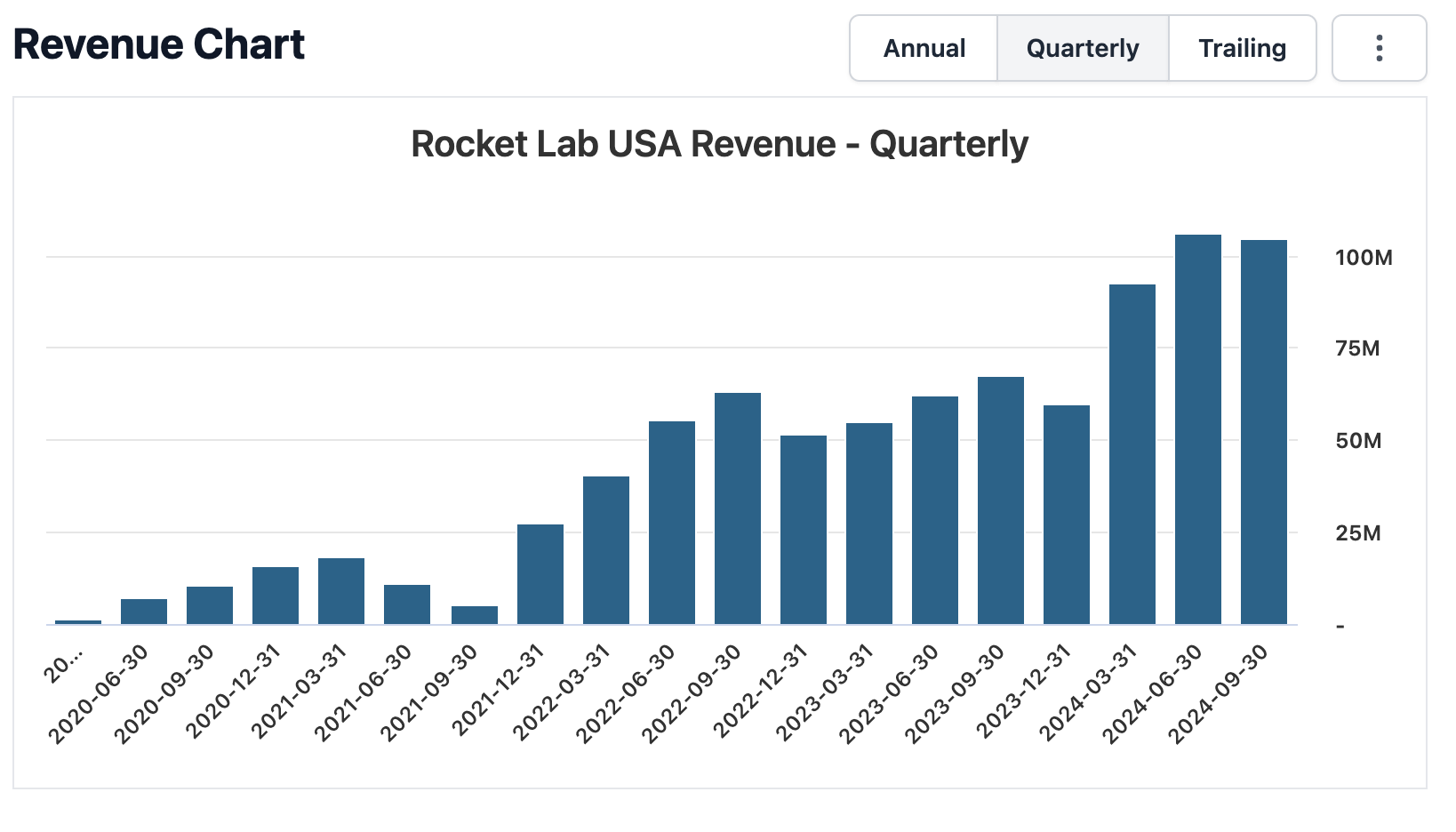
These acquisitions have allowed Rocket Lab to expand its offerings from launch services to satellite components and mission support systems. Consequently, revenue has grown significantly as you can see in the next revenue chart.
What’s coming
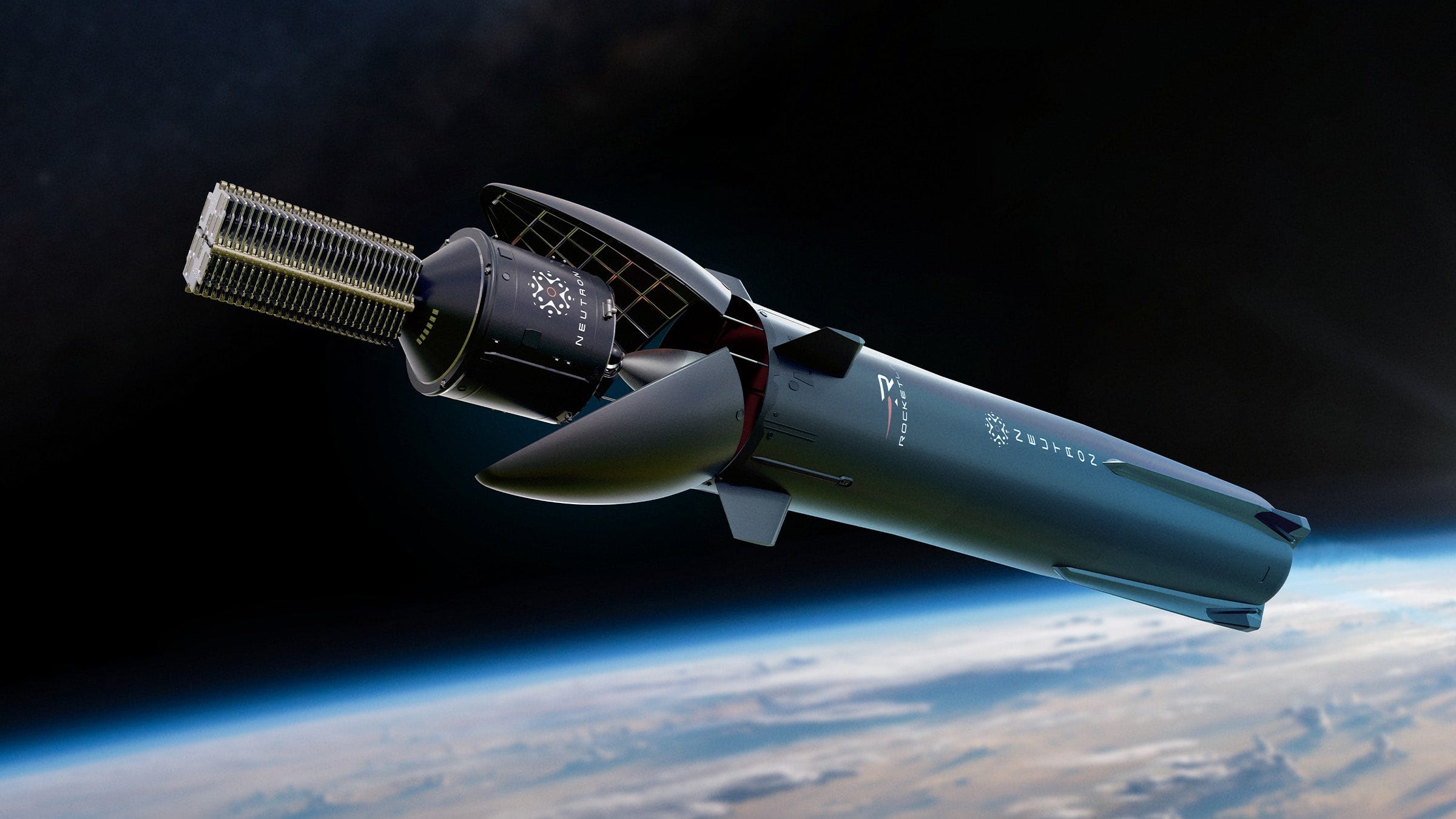
Exciting times are coming for Rocket Lab. On 1 March 2021, the company announced a medium-lift, two-stage launch vehicle called Neutron. It is made of carbon composite and is designed to be capable of delivering a payload up to 13 tonnes. It is expected to start operating this year and will focus on capitalizing on the mega-space constellations delivery market. This could lead to a Rocket Lab proprietary constellation that could reduce costs by self-delivering to lower orbit with Neutron.
An unimaginable number of new use cases could arise as the space economy and technology continue to grow, similar to what happened with the beginning of the internet. In its early stages, the internet was primarily used for military and research communications, file sharing, and a few other niche purposes. Nowadays, it is one of the pillars of our civilization. From my point of view, something similar could happen with space as it becomes democratized and more players are able to take part.
Rocket Lab has spent over two decades developing a platform to provide space services to customers. As their landing page states, it is an end-to-end space company dedicated to helping its customers take their ideas to orbit by providing launch services, complete spacecraft designs and manufacturing, satellite components, flight software, and more.
Here’s the deep dive on Rocket Lab. This is the first time I publish one of my research papers, and it makes me really happy to share it with all of you. Thank you so much for reading the article, and don’t forget to share and subscribe if you enjoyed it!
If you are interested, join eToro and follow or copy my trades at arnaugarcia9 🔥